
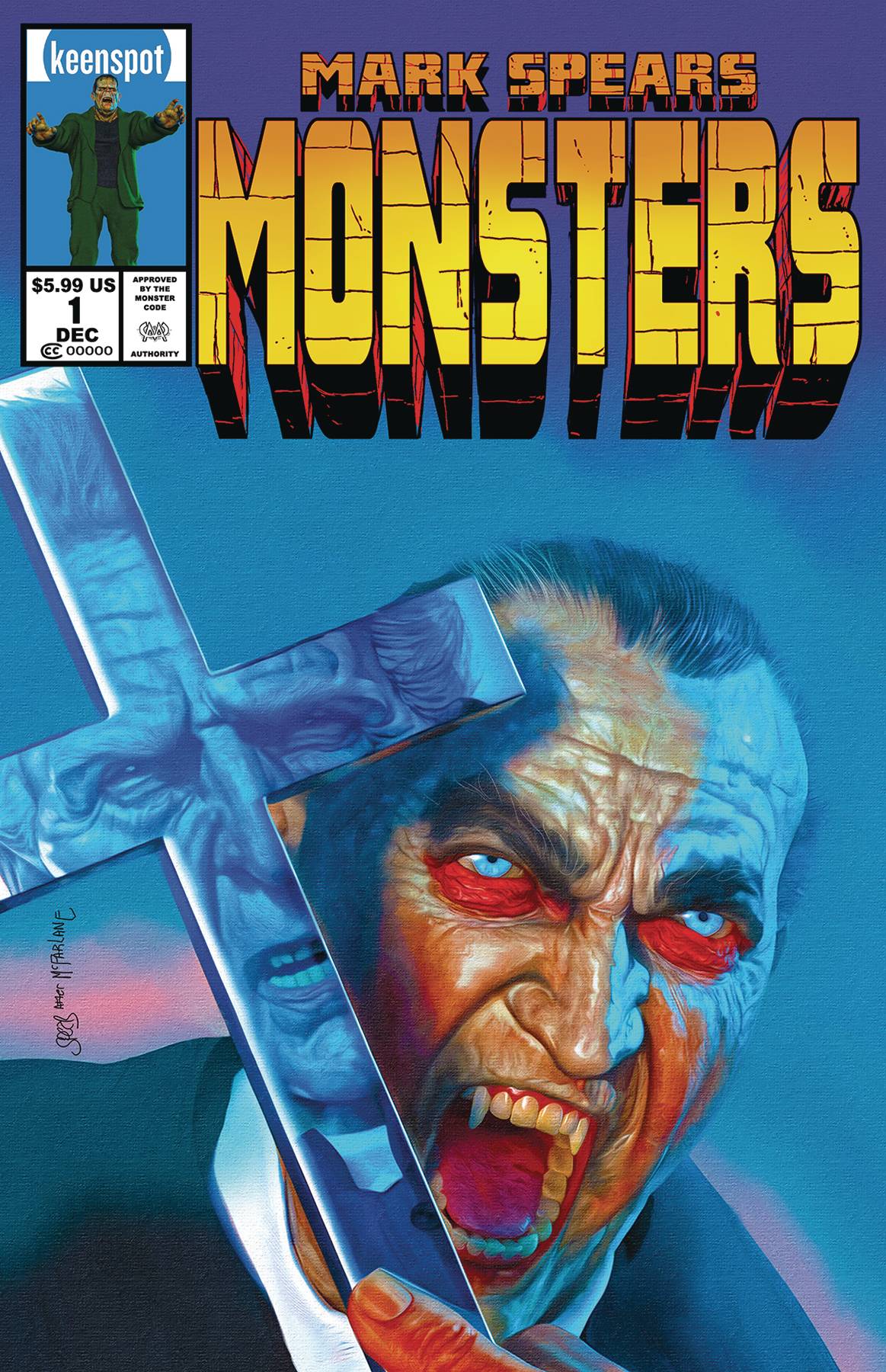
There's something irresistible about the classic monsters. Dracula, Frankenstein's Monster, the Wolf Man, and their fellow creatures of the night have been frightening and fascinating audiences for generations. Whether you first encountered them in Universal horror films, Famous Monsters of Filmland, Aurora model kits, or the pages of Creepy and Eerie, these characters have a way of sinking their claws into your imagination and refusing to let go.
With Mark Spears' Monsters #1, writer and artist Mark Spears brings that old-fashioned monster magic into the modern comic book world. The result is an intriguing, visually distinctive opening chapter that owes as much to the horror nostalgia of the 1980s as it does to the gothic traditions that inspired these creatures in the first place.
Set in 1981, the story opens with a series of disturbing events, including a grisly murder, a missing child, and the suggestion that something ancient and terrible is stirring. A mysterious monster hunter known as the Slayer emerges from retirement, while a collection of seemingly unrelated characters find themselves drawn toward an approaching supernatural threat. Before long, it becomes clear that Dracula's return may be at the center of it all.
One of the issue's more intriguing sequences is a flashback revealing that Dracula was previously imprisoned by an unlikely alliance of legendary Victorian adventurers: Sherlock Holmes, Allan Quatermain, Abraham Van Helsing, and the mysterious Slayer. It's a wonderfully pulpy combination of characters, reminiscent of Alan Moore's The League of Extraordinary Gentlemen, and exactly the sort of literary crossover that appeals to my fondness for Victorian adventure fiction and classic horror.
Curiously, the flashback is introduced with a caption reading "London, England. 1986." Considering the main story takes place in 1981, I'm inclined to believe this is a typographical error and the intended date is 1896. Not only would that place the events squarely within the Victorian era, but the artwork shifts to black and white, visually reinforcing the sense that we're witnessing a much earlier period. More importantly, it raises an intriguing question about the Slayer himself. If he helped imprison Dracula in 1896 and remains active in 1981, he's clearly no ordinary mortal. Whether this extraordinary longevity is supernatural in origin or something else entirely remains to be seen, but it's one of the more interesting mysteries introduced in this opening issue.
Spears doesn't attempt to explain everything in this first installment. Instead, he introduces several characters and plot threads, allowing the mystery to build as the reader begins to piece together their connections. It's an ambitious approach, although the constant movement between storylines occasionally makes the issue feel more like an extended prologue than a complete chapter.
The artwork is unquestionably the comic's most distinctive feature. Spears employs a highly rendered digital painting style that gives his monsters an almost three-dimensional appearance. His dramatic lighting, rich colors, and elaborate character designs create images that would look perfectly at home on the packaging of a premium collectible figure or the cover of a vintage monster magazine.
Unfortunately, that visual richness sometimes comes at the expense of sequential storytelling. Reading Mark Spears' Monsters occasionally feels like looking at a comic book through a View-Master. Each panel is a beautifully rendered, almost three-dimensional illustration, but the sense of movement between those panels is sometimes missing. Rather than flowing naturally from one moment to the next, the story can feel like a succession of elaborate still images.
Compounding this problem is the occasional absence of traditional comic book sound effects. A well-placed CRASH!, THUD!, or BLAM! might seem unnecessary in artwork this detailed, but those familiar visual cues serve an important storytelling function. They convey impact, suggest motion, and give action sequences a rhythm that even the most beautifully rendered illustrations can't always achieve on their own.
This becomes particularly noticeable when an action is communicated through a series of otherwise disconnected images. Without the visual punctuation of a sound effect, the reader must sometimes work harder than necessary to understand exactly what has happened. The problem isn't that Spears needs to fill every panel with oversized lettering and explosive onomatopoeia. It's that the absence of those elements occasionally makes an already static sequence more difficult to follow.
Comic books are, after all, a unique marriage of words and pictures. The best artists understand that what happens between the panels can be just as important as what appears inside them. When that visual continuity breaks down, even the most spectacular illustrations can struggle to communicate a relatively simple action.
It's an interesting contradiction. Spears' artwork is so meticulously detailed that individual panels practically demand to be studied, yet that same quality can interrupt the pacing of the story. The images are wonderful to look at, but they don't always work together as effectively as they should.
The writing is similarly a mixed bag. There's plenty of atmosphere and an obvious affection for the material, but the first issue introduces so many mysteries that it leaves relatively little room to develop its characters. The result is a story that's easier to admire for its premise and presentation than to become emotionally invested in — at least so far.
What I find most appealing about Monsters, however, is its willingness to embrace the classic horror tradition without treating it as something that needs to be reinvented beyond recognition. There's a sincerity to the project that I appreciate. Spears clearly understands the enduring appeal of these characters and the generations of monster fans who grew up loving them.
In many ways, the comic feels like a spiritual descendant of the monster magazines, trading cards, and illustrated horror collectibles that filled the shelves of hobby shops and comic stores decades ago. That nostalgic quality may ultimately be its greatest strength.
As a first issue, Mark Spears' Monsters offers more questions than answers, and its elaborate visual presentation sometimes overshadows the storytelling. Nevertheless, there's enough atmosphere, mystery, and affection for classic horror to make me curious about what comes next.
For readers who grew up loving the Universal Monsters, Hammer horror films, and the wonderfully lurid monster art of decades past, this is certainly a comic worth investigating.
The verdict: Mark Spears' Monsters #1 is a visually stunning, nostalgia-soaked introduction to a new monster universe. Spears is unquestionably a talented illustrator, but beautiful illustrations and effective sequential storytelling aren't necessarily the same thing. The story hasn't quite found its footing, and the static artwork occasionally makes the action more difficult to follow than it should. Still, there's enough classic monster magic here to make me want to turn the page — even when the artwork makes me want to stop and stare.